Tubeworm Symbiosis and the Evolution of Chemoautotrophy
How Riftia and its relatives illuminate a fundamental mode of life
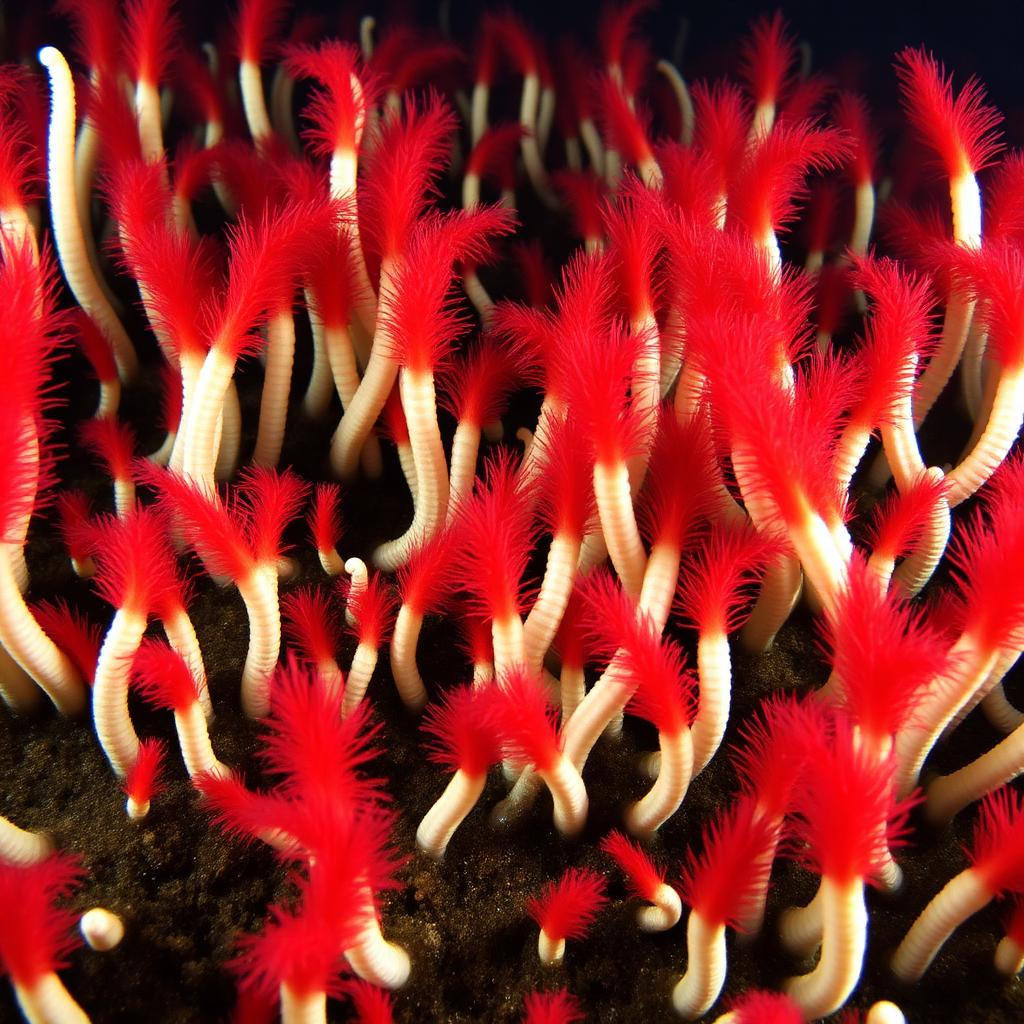
The discovery of large tubeworm communities at Pacific hydrothermal vents in the late 1970s reshaped biology. The most famous of these worms, Riftia pachyptila, has no mouth, no gut, and no anus as an adult. It depends entirely on a specialized internal organ, the trophosome, packed with symbiotic bacteria that oxidize hydrogen sulfide and use the released energy to fix carbon dioxide into organic molecules. The worm supplies the bacteria with sulfide, oxygen, and carbon dioxide via a bright red plume rich in hemoglobin, and receives nutrients in return.
This partnership is one of the clearest examples of chemoautotrophy in a large animal. Chemoautotrophy, in which organisms derive energy from inorganic chemical reactions rather than sunlight or preformed organic material, was long thought to be the exclusive domain of microbes. Vent tubeworms show that entire animal communities can be built around it. Similar symbioses have since been documented in cold-seep tubeworms, bivalves, and various invertebrates in whale-fall and wood-fall communities.
Detailed study of Riftia has revealed several extraordinary adaptations. Adult worms have specialized hemoglobins that carry both oxygen and hydrogen sulfide without allowing the sulfide to poison their tissues. The trophosome contains chambers where bacterial density is carefully regulated, and the worm modulates blood flow to control the environment its symbionts experience. Even the process of acquiring the bacteria is unusual: larvae enter the vent environment without symbionts, and juvenile worms take up bacteria from the surrounding water shortly after settling, forming a fresh partnership in each generation.
The evolutionary origins of tubeworm chemoautotrophy remain an active area of research. Molecular studies suggest that the symbiosis arose multiple times independently in different lineages, each time from ancestors that likely had more conventional feeding modes. This convergence highlights how reliably deep-sea environments select for chemosymbiosis when reduced chemistry is available.
Beyond biology, tubeworms have implications for astrobiology. If chemoautotrophic ecosystems can flourish around Earth's hydrothermal vents, similar communities might exist on other worlds with subsurface oceans and rocky interiors. Europa, Enceladus, and possibly Titan are candidates for such environments. Studying vent tubeworms and their microbial partners helps constrain what to look for in searches for extraterrestrial life.
Conservation and management issues also arise. Hydrothermal vents are candidates for deep-sea mining, and tubeworm communities are among the most conspicuous casualties of any physical disturbance. Vent fields are typically small, patchy, and short-lived on geological timescales, but individual sites can host distinct communities that would take decades or centuries to reestablish if destroyed. Careful protection of at least a representative sample of vent habitats is widely supported by the scientific community.
Ongoing research uses genomic, transcriptomic, and metabolomic tools to explore how symbionts and hosts coordinate their biology. New sampling approaches, including in situ preservation of tissues at depth, allow molecular studies that were impossible a decade ago. Long-term seafloor observatories provide continuous monitoring of vent communities and allow scientists to correlate biological changes with environmental variability in unprecedented detail.
For the general reader, vent tubeworms are one of the most powerful reminders that life can be built on unfamiliar foundations. Sunlight is not required. Carbon fixation can be powered by hydrogen sulfide. Symbiosis can replace individual metabolism. Every one of these facts changed our understanding of biology, and each one traces back to a small red worm growing in complete darkness two thousand meters below the sea surface.
Vent tubeworms depend entirely on symbiotic bacteria for nutrition. Their biology has become a central model for understanding chemoautotrophic ecosystems.
Continue reading
 Deep Sea Research Review
How Climate Change Reaches the Deep Ocean
Warming, deoxygenation, and acidification below the surface
 Deep Sea Research Review
A Review of Abyssal Fish Diversity Across Ocean Basins
How different basins support different abyssal fish communities
 Deep Sea Research Review
Citizen Science Comes to the Deep Sea
How volunteer image classification is accelerating deep-sea discovery