Life on Manganese Nodules: A Fragile Ecosystem in the Spotlight
Why potato-sized rocks on the abyssal plain host communities that took millions of years to form
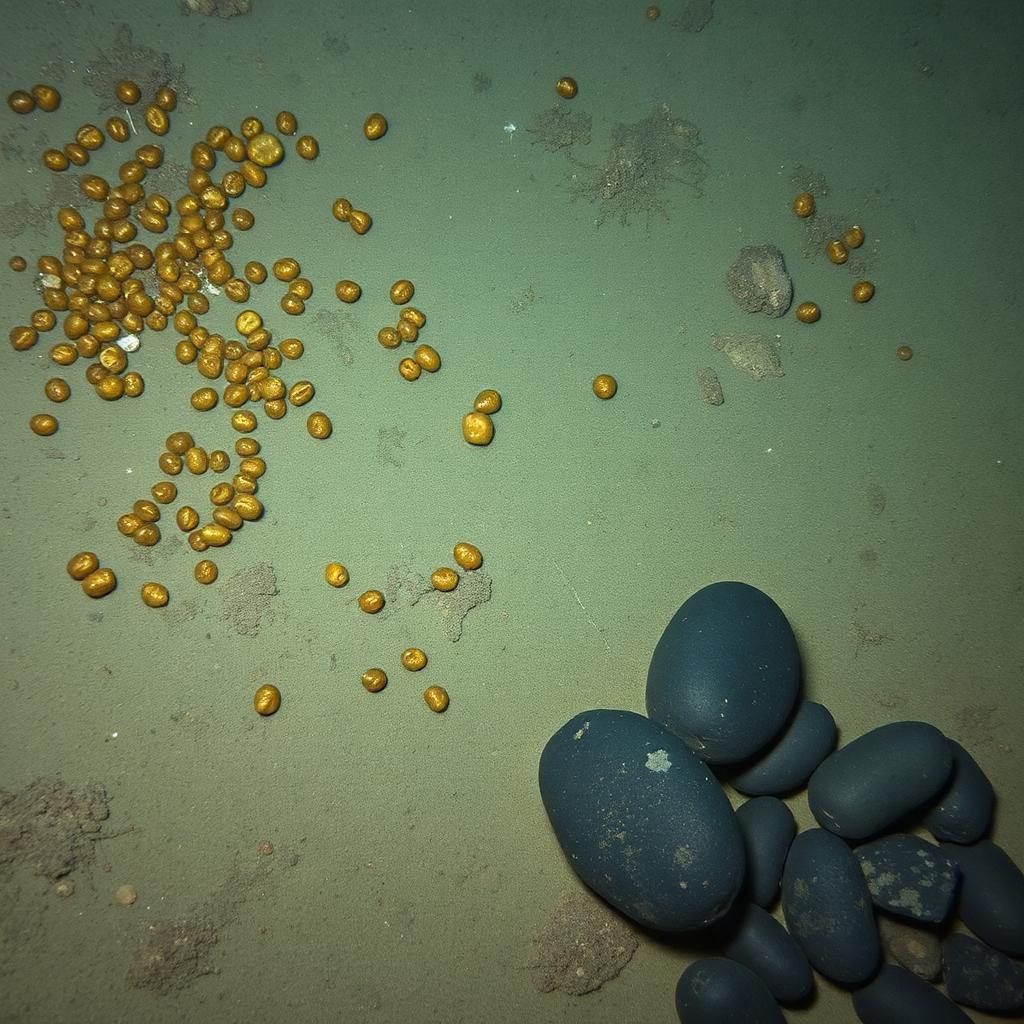
Manganese nodules are potato-sized concretions of metal-rich minerals that cover parts of the abyssal seafloor at depths between about four thousand and six thousand meters. They grow extremely slowly, adding only a few millimeters per million years as metals precipitate out of seawater and pore fluids. In many parts of the Pacific Ocean, entire fields of nodules stretch across the seafloor like scattered cobblestones.
For a long time, scientists studied nodules mainly for their mineral content. They contain economically significant amounts of manganese, nickel, copper, and cobalt, all of which are important for modern technologies including battery production. This economic potential has attracted the attention of mining companies and national governments, who see nodule fields as a possible source of strategic metals.
Biological research over the past decade has changed how nodule fields are understood. Detailed surveys of the Clarion-Clipperton Zone in the eastern Pacific have shown that nodule-covered seafloor supports very different communities from areas of bare sediment. Many species of sponges, corals, anemones, and encrusting invertebrates live directly on the nodule surfaces because the rocks provide the only hard substrate in an otherwise soft-sediment environment.
Genetic and morphological analyses of collected specimens suggest that a large fraction of nodule-dwelling species are new to science. Some studies estimate that more than half of the animals found on nodules have never been formally described. This has raised important questions about how to manage a habitat whose biodiversity is not yet fully cataloged and whose ecological relationships are only beginning to be understood.
The slow growth of the nodules themselves creates a serious conservation problem. Because the rocks take millions of years to form, they cannot be replaced on any human timescale. Any mining operation that removes nodules from a given area effectively eliminates that hard-substrate habitat for the foreseeable future. Communities dependent on the nodules would need to find alternative substrates or disappear locally.
Impact experiments carried out decades ago, in which small areas of nodule-covered seafloor were disturbed by simple plows, still show visible tracks and reduced faunal density today. This slow recovery suggests that even limited disturbance can have long-lasting effects. Modern mining tests generate much larger disturbances, both by removing nodules and by resuspending sediment plumes that can travel long distances.
The nodule debate has become a focus for international deep-sea governance. Regulatory bodies, most notably the International Seabed Authority, are actively negotiating the rules that would apply to any commercial extraction in areas beyond national jurisdiction. Scientific input into these negotiations is essential, both to characterize the ecosystems at risk and to help design monitoring programs that could detect impacts early.
For anyone thinking about the future of the deep sea, manganese nodule fields are a compact case study. A slow-growing, mineral-rich, biologically important habitat sits at the intersection of economic pressure and scientific uncertainty. Decisions made now will shape a landscape whose natural rhythms operate on timescales far longer than any human institution.
Manganese nodule fields are more than mineral deposits. They are long-lived habitats whose recovery from disturbance is measured in millions of years.
Continue reading
 Deep Sea Research Review
How Climate Change Reaches the Deep Ocean
Warming, deoxygenation, and acidification below the surface
 Deep Sea Research Review
A Review of Abyssal Fish Diversity Across Ocean Basins
How different basins support different abyssal fish communities
 Deep Sea Research Review
Citizen Science Comes to the Deep Sea
How volunteer image classification is accelerating deep-sea discovery