Hydrothermal Vents: Chemosynthesis and the Origins of Life
Superheated fluid, tube worms, and a food web that does not need the sun
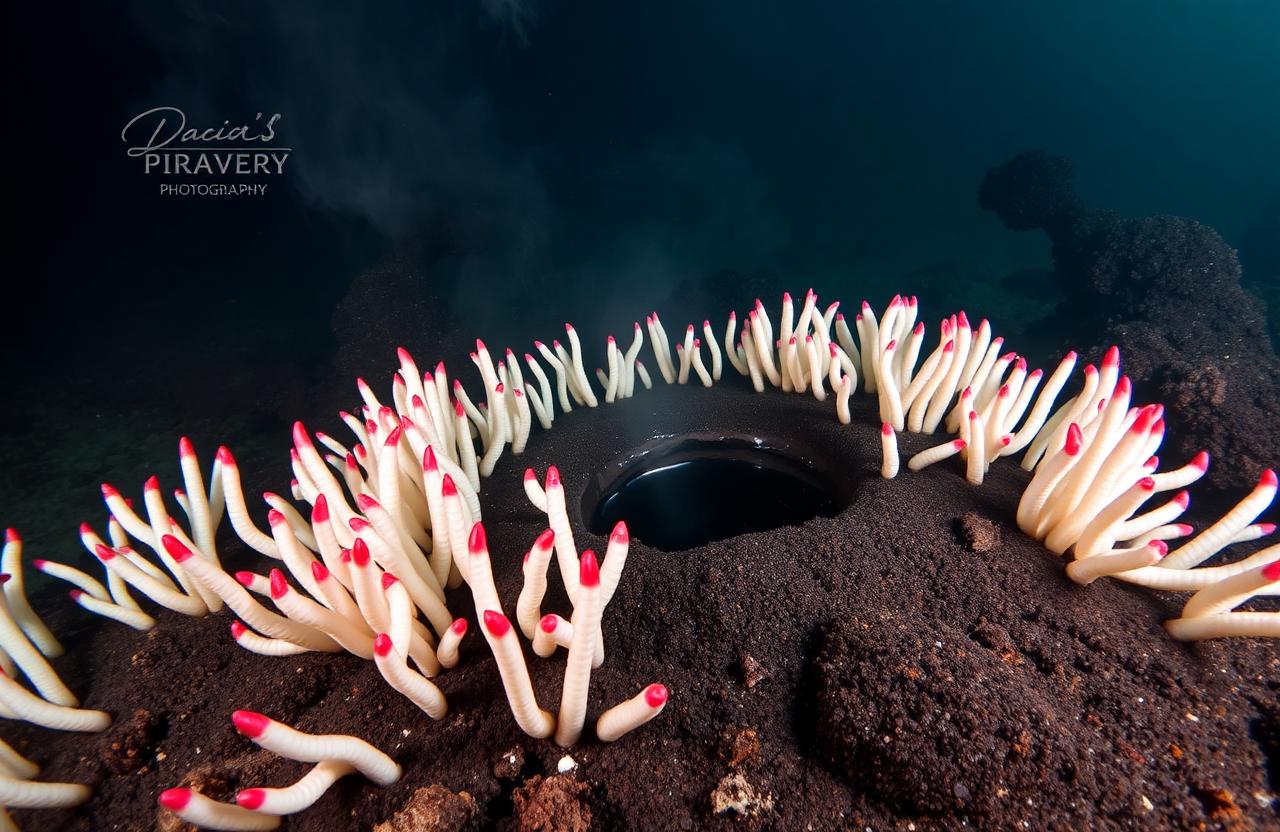
In 1977, a team aboard the deep submergence vehicle Alvin descended two and a half kilometers into the Galapagos Rift and found something that biology textbooks said should not exist. Rising from cracks in the seafloor were plumes of shimmering hot water, and clustered around them were dense communities of clams, mussels, crabs, and enormous red-tipped tube worms. There was no sunlight, no photosynthesis, no obvious source of energy. Yet the ecosystem thrived. The discovery of hydrothermal vent communities fundamentally changed how scientists understand the limits of life.
The engine of a vent ecosystem is chemistry, not light. Seawater seeps into cracks in young ocean crust, contacts hot rock near magma chambers, and returns to the seafloor loaded with dissolved minerals and reduced compounds such as hydrogen sulfide, methane, and hydrogen gas. At the vent openings, chemosynthetic bacteria and archaea use these reduced molecules the way plants use sunlight: as an energy source to fix inorganic carbon into sugars. Every other animal at the vent depends, directly or indirectly, on this microbial productivity.
The signature animals of many Pacific vents are the giant tube worms of the species Riftia pachyptila. Adults can grow more than two meters long and have no mouth, no gut, and no anus. Instead, their bodies house a specialized organ called the trophosome that is packed with symbiotic bacteria. The worm absorbs hydrogen sulfide, oxygen, and carbon dioxide through its bright red plume, transports them via hemoglobin-rich blood, and delivers them to the bacteria. In return, the bacteria produce nutrients that feed the worm. It is one of the most complete metabolic partnerships known.
Other vent specialists include the scaly-foot snail Chrysomallon squamiferum, whose foot is armored with iron sulfide scales; the yeti crab Kiwa hirsuta, which cultivates bacteria on the setae covering its arms and grazes on them; and the Pompeii worm Alvinella pompejana, one of the most heat-tolerant animals known, thriving in temperature gradients that can exceed sixty degrees Celsius over a few centimeters.
Vent fields are patchy and short-lived. Individual chimneys may grow, become inactive, and collapse over decades or centuries. Vent animals therefore have life cycles that include dispersing larvae capable of finding new active sites across tens or hundreds of kilometers of empty seafloor. Genetic studies show that vent species along a single mid-ocean ridge often exchange enough larvae to maintain connected populations, but that widely separated ridge systems host distinct communities.
Because chemosynthesis does not require sunlight, hydrothermal systems have become a leading candidate for the environment in which life on Earth first appeared. Alkaline vent hypotheses propose that mineral-lined pores in ancient vents provided the chemical and physical gradients needed to concentrate simple organic molecules and drive early metabolism. Similar systems may exist beneath the ice of Europa and Enceladus, which is one reason vent research has become a shared interest of biologists and astrobiologists.
Human interest in vents is not purely academic. Massive sulfide deposits form as vent fluids cool, and they are enriched in copper, zinc, gold, and other metals that global markets increasingly value. Several companies have proposed mining inactive vent fields, and a few countries have already granted exploration licenses. Scientists warn that even inactive fields host distinctive communities and act as stepping stones for larval dispersal across ridge systems. The scientific consensus is that mining should proceed, if at all, only with strict safeguards and long-term monitoring.
Vents remind us that life is far more flexible than any single ecosystem suggests. In just a few decades, they have moved from a curious anomaly to a central case study in how ecosystems assemble, how life may have begun, and how humans decide which parts of the deep sea to exploit and which to protect. Every new expedition to a ridge system adds species to the record, and each of those species is a small argument for treating the deep ocean with more care than we have historically shown.
Hydrothermal vents host self-sustaining ecosystems built on chemistry instead of sunlight. Studying them changed biology and reshaped theories about how life began.
Continue reading
 Deep Sea Creatures Popular Science
Life in the Midnight Zone: A Field Guide to the Bathypelagic
How animals survive between 1,000 and 4,000 meters of perpetual darkness
 Deep Sea Creatures Popular Science
The Anglerfish's Lantern: Anatomy of a Deep-Sea Ambush Predator
How ceratioid anglerfishes evolved bacterial lures, extreme jaws, and parasitic males
 Deep Sea Creatures Popular Science
Bioluminescent Signaling: The Grammar of Deep-Sea Light
How pulses, patterns, and colors carry information in the dark ocean