The Anglerfish's Lantern: Anatomy of a Deep-Sea Ambush Predator
How ceratioid anglerfishes evolved bacterial lures, extreme jaws, and parasitic males
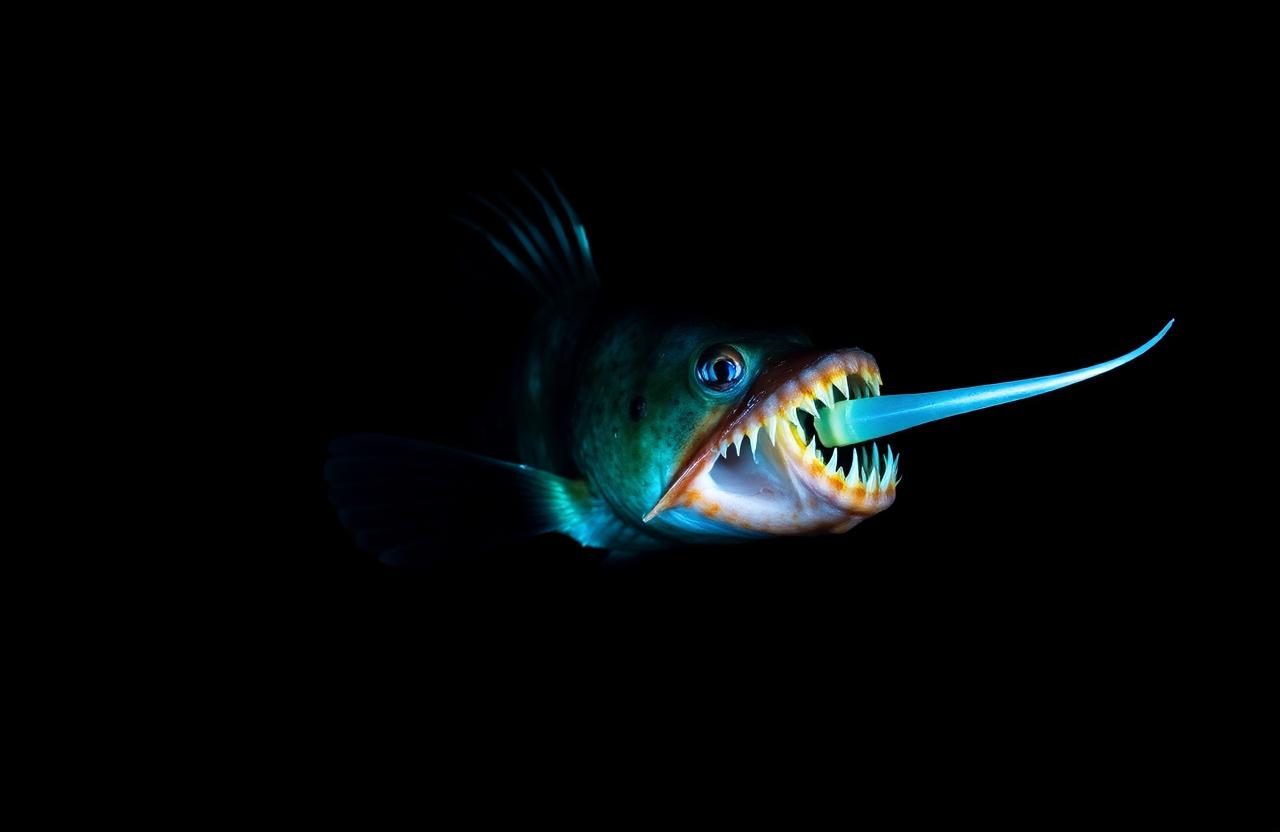
Anglerfishes of the suborder Ceratioidei are among the most instantly recognizable inhabitants of the deep ocean. The image of a soft, dark-skinned fish holding a glowing lure above its enormous jaws has appeared in countless documentaries, and it has become shorthand for the strangeness of life in the abyss. Behind that familiar silhouette lies one of the most highly specialized bodies in the vertebrate world, sculpted by hundreds of millions of years of evolution in a low-food, high-pressure environment.
The lure, known as an esca, sits at the tip of a modified dorsal spine called the illicium. Inside the esca live symbiotic bioluminescent bacteria, usually in the genus Photobacterium. The fish cannot produce light on its own; instead, it cultivates a bacterial colony inside a specialized pore-lined chamber, feeding the bacteria with nutrients from its own tissues and controlling brightness through changes in blood flow and pore opening. The bacteria are acquired anew by each fish from the surrounding seawater, which means that every anglerfish grows up dark and must find and cultivate its own lantern.
The jaws and stomach of a female ceratioid are engineered for opportunism. Because prey is rare, the fish cannot afford to be selective. Its jaws hinge open to an enormous gape, and its stomach expands to hold prey nearly as large as itself. Long, inward-facing teeth ensure that once something enters the mouth, it rarely escapes. The gut walls contain elastic fibers that let the fish digest a meal over days or even weeks. This ambush-and-swallow strategy is well suited to a world where a single successful strike may provide enough energy for a month of slow drifting.
The most extraordinary feature of many ceratioid species is their reproductive strategy. Females are relatively large, sometimes reaching the size of a soccer ball. Males, by contrast, are tiny, often less than a tenth the length of the female. They have no functional digestive system as adults and possess enormous olfactory organs that let them detect species-specific pheromones from great distances. When a male finds a female, he bites into her skin and gradually fuses with her body. In several species, the two circulatory systems merge, and the male becomes a permanent sperm-producing appendage. A single female may carry several parasitic males at once.
This system, known as sexual parasitism, only works because the deep sea makes finding a mate spectacularly difficult. Chance encounters between two adults of the same species are so rare that natural selection has favored a strategy that guarantees permanent access to gametes once contact is made. Sexual parasitism has evolved independently in multiple anglerfish lineages, showing how strongly the deep-sea environment shapes reproductive biology.
Ceratioid anglerfishes are found in nearly every ocean, from the tropics to the polar seas, at depths ranging from around three hundred meters to well below three thousand. Different genera specialize in different depths and prey types. Some, like the humpback anglerfish, drift in open midwater. Others, like the wolftrap anglers, prefer waters closer to the seafloor. Despite this diversity, all ceratioids share the general body plan of a soft, dark, roughly spherical predator built for patient ambush.
Studying anglerfishes remains difficult. Their bodies deteriorate rapidly when brought to the surface, and their behavior is nearly impossible to observe in captivity. Most of what scientists know comes from preserved trawl specimens and, more recently, from a small number of extraordinary submersible encounters. A 2018 video captured off the Azores showed a female anglerfish with an attached male drifting through midwater with her lure and body filaments glowing softly. That single clip added more behavioral information than decades of jarred specimens.
Anglerfishes offer a compact lesson in how the deep sea reshapes bodies. Bacterial partnerships, hinged jaws, elastic stomachs, and permanent mate fusion are not eccentric novelties. They are precise engineering solutions to the same problem faced by every animal in the abyss: how to find enough food and enough partners in a world that is almost entirely empty.
Anglerfishes are the poster animals of the deep sea. Their bacterial lures, hinged jaws, and parasitic mating systems reflect a lineage shaped entirely by darkness.
Continue reading
 Deep Sea Creatures Popular Science
Life in the Midnight Zone: A Field Guide to the Bathypelagic
How animals survive between 1,000 and 4,000 meters of perpetual darkness
 Deep Sea Creatures Popular Science
Hydrothermal Vents: Chemosynthesis and the Origins of Life
Superheated fluid, tube worms, and a food web that does not need the sun
 Deep Sea Creatures Popular Science
Bioluminescent Signaling: The Grammar of Deep-Sea Light
How pulses, patterns, and colors carry information in the dark ocean