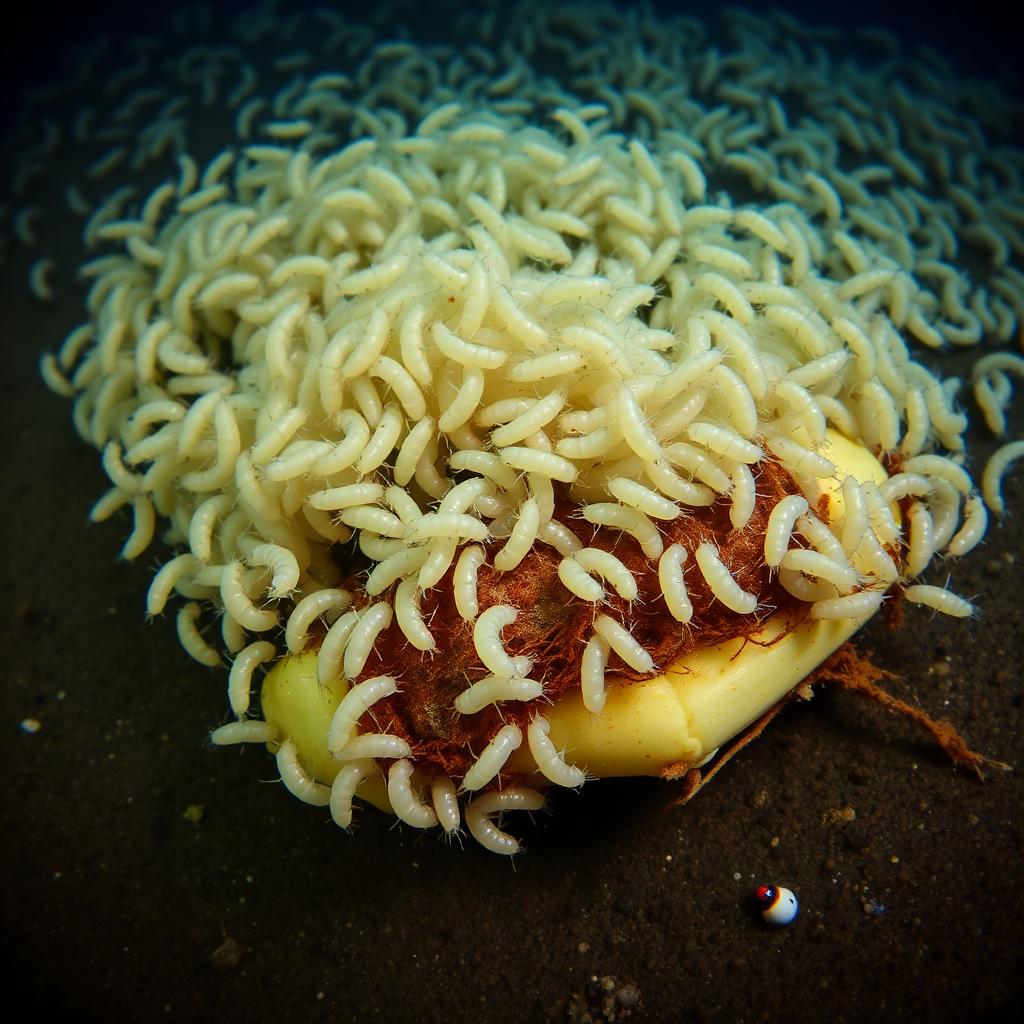
Amphipods of the Hadal Zone: Small Scavengers of the Deepest Trenches
How centimeter-scale crustaceans dominate the deepest food webs
Below six thousand meters, the ocean enters the hadal zone, a series of subduction trenches that reach the deepest points on the planet. Physical conditions here are extreme: pressures above six hundred atmospheres, near-freezing temperatures, and food supplies limited to whatever sinks from far above. Yet baited traps lowered into these trenches consistently return swarms of amphipods, small shrimp-like crustaceans that appear to dominate the hadal scavenger community.
The most studied hadal amphipods belong to genera such as Hirondellea, Alicella, and Eurythenes. They range in size from a few millimeters to more than thirty centimeters in the case of the giant Alicella gigantea. Their exoskeletons, mouthparts, and digestive systems are adapted to break down and extract nutrients from a wide range of organic material, including sunken carcasses of surface animals, wood, and plant debris. Some species even harbor gut bacteria capable of digesting cellulose, which lets them exploit terrestrial plant fragments that reach the trenches through rivers and storm systems.
Deep-sea gigantism, in which certain groups produce larger species at greater depths, is well illustrated by hadal amphipods. Alicella gigantea can reach body lengths that dwarf its shallow-water relatives. Several explanations have been proposed, including reduced predator pressure, cold-driven slow metabolism, and the ability to store more energy between infrequent meals. No single explanation is universally accepted, but the pattern is consistent across multiple trench systems.
Behaviorally, hadal amphipods are opportunistic. Baited landers deployed for a few hours often attract dense clouds of them, sometimes numbering in the thousands. Reproduction appears to involve pulses tied to sporadic food falls, though direct observation is very limited. Long-term time-lapse studies suggest that even in the deepest trenches, seasonal signals from far above can influence activity patterns, with slight increases in scavenger response following surface plankton blooms.
Amphipods have also become inadvertent indicators of human impact on the deep sea. Analyses of tissue samples collected from trenches such as the Mariana and Kermadec have revealed persistent organic pollutants, including polychlorinated biphenyls and brominated flame retardants, at concentrations comparable to those found in some polluted coastal environments. These chemicals reach the trenches via slow sinking of contaminated particles from the surface. Their presence in animals living ten kilometers below the surface is a powerful demonstration that no part of the ocean is truly isolated from surface activity.
Microplastic ingestion has been documented in hadal amphipods across multiple trench systems. Fibers and fragments appear in gut contents even in specimens collected far from major shipping lanes. The biological consequences are still being investigated, but the pattern reinforces the same message as the pollutant data: whatever humans put into the surface ocean eventually reaches the deepest parts.
From an ecological perspective, amphipods appear to occupy a keystone role in hadal food webs. They rapidly consume large food falls, break tissue into smaller particles that other animals can use, and become prey themselves for the few fishes and other predators that live at these depths. Removing them from the trench community, even hypothetically, would likely disrupt nutrient cycling in ways that are difficult to predict.
For all these reasons, amphipods deserve more attention than their size might suggest. They are the workhorses of the hadal zone, and they carry within their bodies a record of ocean chemistry and human behavior stretching from the surface to the seafloor. Studying them is one of the most direct ways to understand both the ecology and the vulnerability of the deepest ocean.
Amphipods are the most conspicuous animals at hadal depths. Their scavenging biology, gigantism, and pollutant burdens tell a larger story about the connected ocean.
Continue reading
 Deep Sea Creatures Popular Science
Life in the Midnight Zone: A Field Guide to the Bathypelagic
How animals survive between 1,000 and 4,000 meters of perpetual darkness
 Deep Sea Creatures Popular Science
The Anglerfish's Lantern: Anatomy of a Deep-Sea Ambush Predator
How ceratioid anglerfishes evolved bacterial lures, extreme jaws, and parasitic males
 Deep Sea Creatures Popular Science
Hydrothermal Vents: Chemosynthesis and the Origins of Life
Superheated fluid, tube worms, and a food web that does not need the sun