Cold-Water Coral Mounds of the North Atlantic
Reef-building corals thrive in cold, deep water and support diverse communities
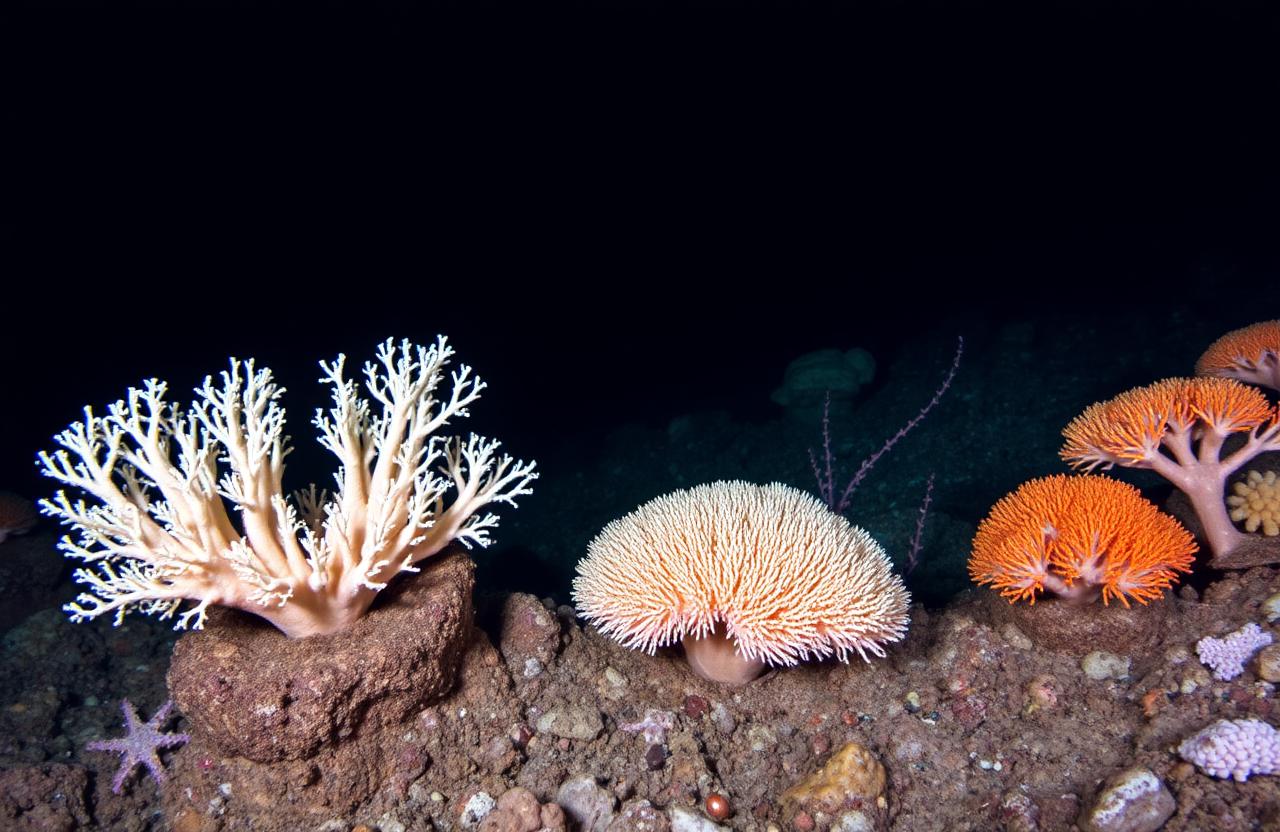
When most people picture a coral reef, they imagine warm, sunlit water and brightly colored fish. Yet some of the largest coral structures on Earth grow in cold, dark water hundreds or even thousands of meters below the surface. Along the continental slopes of the North Atlantic, species such as Lophelia pertusa and Madrepora oculata form mounds that can rise more than three hundred meters above the seafloor and stretch for kilometers in length.
Cold-water corals differ from their tropical cousins in one critical respect: they do not host symbiotic algae. Instead of depending on sunlight, they feed on zooplankton and organic particles carried by ocean currents. This allows them to grow at temperatures between four and eight degrees Celsius and at depths where sunlight is absent. Where currents converge and deliver a steady flow of food, coral colonies can persist for thousands of years, layering skeleton upon skeleton to form durable carbonate mounds.
The most famous of these systems is the Mingulay Reef Complex west of Scotland, along with extensive mound provinces off Ireland, Norway, and Iceland. Multibeam surveys and submersible dives have shown that many mounds host hundreds of associated species, including sponges, brittle stars, squat lobsters, and commercially valuable fishes such as redfish and ling. The complexity of the coral structure provides shelter, feeding grounds, and nursery habitat that plain sedimentary seafloor simply cannot offer.
The age of these systems is remarkable. Radiometric dating of coral skeletons and mound sediments shows that some mounds began forming more than two million years ago, though individual colonies live on the order of decades to centuries. Growth is slow, on the order of a few millimeters per year for individual corals. The mounds themselves are essentially records of long-term interactions between coral biology, current regimes, and sediment supply.
Cold-water corals face several serious threats. Bottom trawling has caused extensive physical damage to reef complexes in past decades; single tows can pulverize centuries of growth. Ocean acidification, driven by rising atmospheric carbon dioxide, reduces the availability of the aragonite mineral that corals use to build their skeletons. Modeling studies project that large portions of the North Atlantic will become unsuitable for cold-water coral growth within a century if emissions continue at current rates.
Conservation responses have grown over the past two decades. Several countries have designated cold-water coral areas as marine protected areas or closed them to bottom trawling. The European Union has restricted destructive fishing gear on many known coral mounds. Nonetheless, enforcement is uneven, and mapping remains incomplete in many regions. Every new survey typically reveals additional reef structures that require assessment.
Scientific interest in cold-water corals is also driving methodological innovation. Autonomous vehicles equipped with high-resolution cameras and environmental sensors can now survey mound systems over multiple days at a time, producing detailed maps of coral cover and current regimes. Environmental DNA sampling from water columns above mounds provides an efficient way to identify associated species without physical collection.
For readers new to the topic, the takeaway is straightforward. Deep-sea ecosystems are not a monoculture of soft mud and darkness. They include reef systems that rival tropical ones in biodiversity and antiquity, built by animals that never see the sun. Protecting them requires the same combination of good maps, effective regulation, and honest scientific communication that any other marine conservation issue demands.
Cold-water corals build kilometer-scale mounds along continental slopes and support ecosystems as diverse as many shallow reefs.
Continue reading
 Deep Sea Creatures Popular Science
Life in the Midnight Zone: A Field Guide to the Bathypelagic
How animals survive between 1,000 and 4,000 meters of perpetual darkness
 Deep Sea Creatures Popular Science
The Anglerfish's Lantern: Anatomy of a Deep-Sea Ambush Predator
How ceratioid anglerfishes evolved bacterial lures, extreme jaws, and parasitic males
 Deep Sea Creatures Popular Science
Hydrothermal Vents: Chemosynthesis and the Origins of Life
Superheated fluid, tube worms, and a food web that does not need the sun